DVB Inspector
Digitalekabeltelevisie.nl
User manual
Tree view - PSI
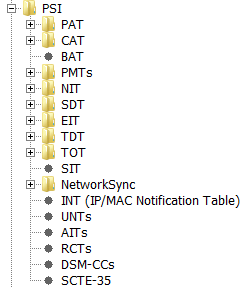 The PSI section is always shown. It shows
a folder for every table that is present, a black dot means this
table is not used in the current TS.
The PSI section is always shown. It shows
a folder for every table that is present, a black dot means this
table is not used in the current TS.
A folder can be expanded by clicking on the '+' to the left of it.
In this example no BAT is present, and the SIT, INT, UNT, AIT, RCT, DSM-CC and SCTE-35 tables are also not used.
PAT
The Program Association Table (PAT) indicates the location (the Packet Identifier (PID) values of the Transport Stream (TS) packets) of the corresponding Program Map Table (PMT). It also gives the location of the Network Information Table (NIT).
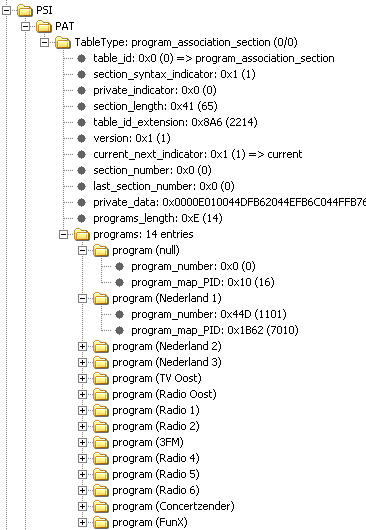 This is the normal view of
the PAT table. The first part is common for all SI tables, and
shows details like tabel_id, section_syntax_indicator, etc.
This is the normal view of
the PAT table. The first part is common for all SI tables, and
shows details like tabel_id, section_syntax_indicator, etc.
The field private data shows the RAW data of the table, both as hexadecimal data, and ASCII representation.
Then the data for the table is shown. A PAT is not very complicated, the first entry (program) refers to the NIT, as defined in the MPEG2 standard ISO13818-1. (Remark, some providers do not use a program with number 0 to point to the NIT.) The other entries refer to the PMTs for the services. The name between () is looked up in the SDT.
CAT
The Conditional Access Table (CAT) provides information on the CA systems used in the multiplex; the information is private (not defined within ETSI EN 300 468) and dependent on the CA system, but includes the location of the EMM stream, when applicable.
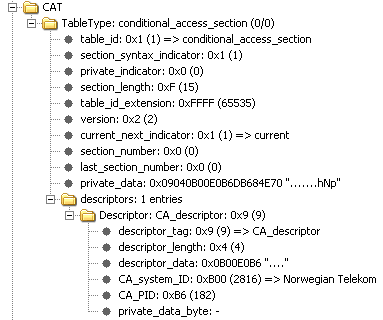 Although this TS contains no
encrypted channels, it is part of a service (Digitenne) that
contains encrypted channels on other frequencies. Thus a CAT is
present.
Although this TS contains no
encrypted channels, it is part of a service (Digitenne) that
contains encrypted channels on other frequencies. Thus a CAT is
present.
BAT
The Bouquet Association Table (BAT) provides information regarding bouquets. As well as giving the name of the bouquet, it provides a list of services for each bouquet.
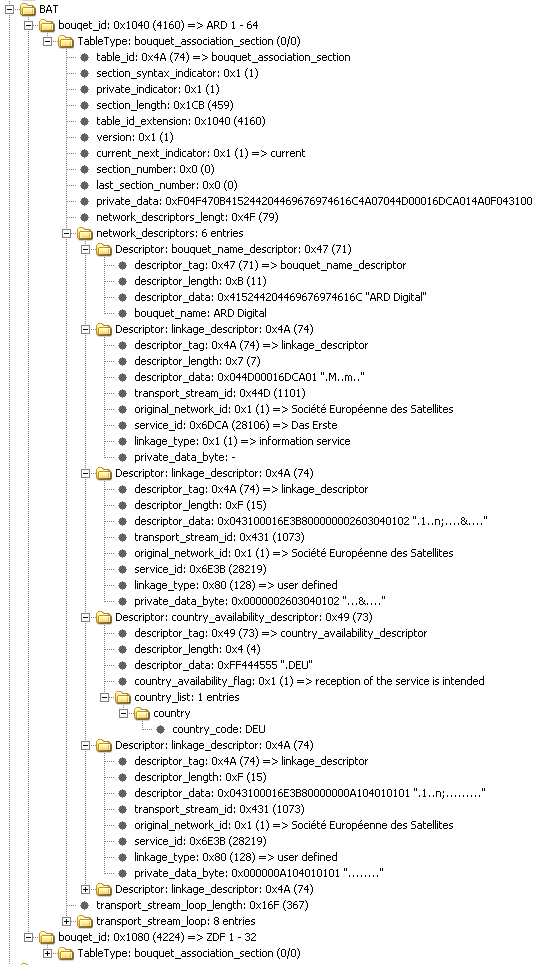
ETSI EN 300 468
defines a Bouquet Association Table (BAT) as optional. The Dutch
Digitenne service does not use a BAT, the German broadcaster ZDF
uses a BAT on its Astra satellite service. The picture shows the
BAT of the ZDF.
PMTs
A Program Map Table (PMT) identifies and indicates the locations of the streams that make up a service, and the location of the Program Clock Reference (PCR) fields for a service. There is a PMT for each service in a transport stream.
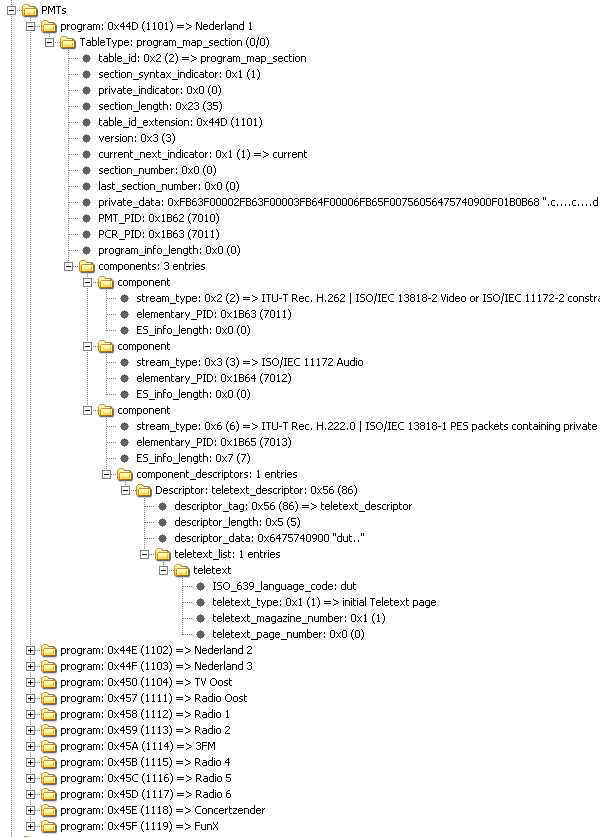
The PMTs are found
through the PAT table, and grouped together for easy viewing.
NIT
The Network Information Table (NIT) is intended to provide information about the physical network.
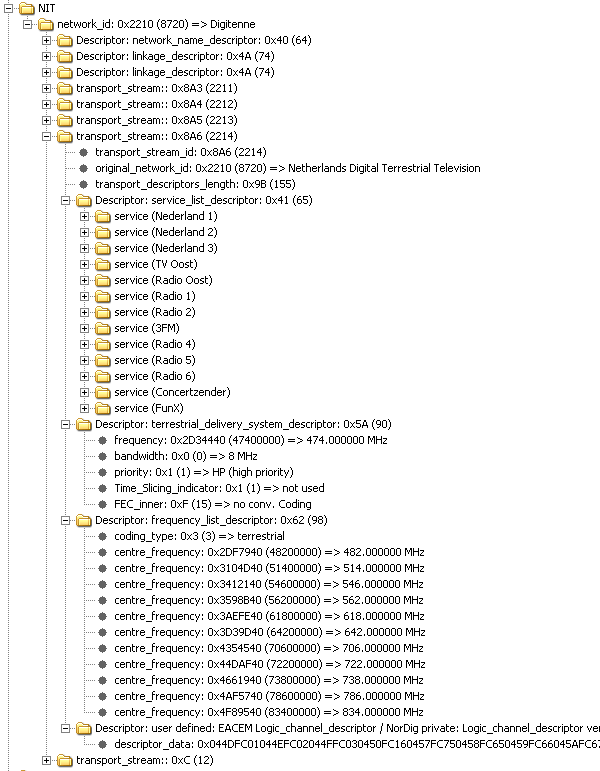
This is the NIT
as provided by Digitenne. This example shows a user defined
descriptor with tag value 0x83. This should have been preceded by
a Private data specifier descriptor, but often this is omitted.
Therefore DVB Inspector has no way to know how to interpret this
descriptor, and shows only the raw data. See "options" to find out how to force
DVB Inspector to interpret private descriptors.
SDT
The Service Description Table (SDT) contains data describing the services in the system like names of services, the service provider, etc.
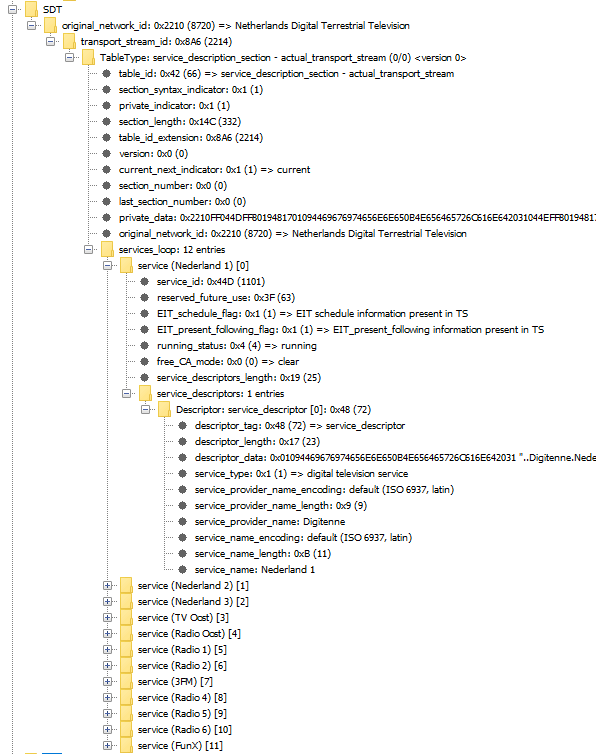
This is the SDT
of the Digitenne service. It only shows the SDT for the actual
transport stream. Some providers also transmit SDTs for other
transport streams,but this is not required.
EIT
The EIT contains data concerning events or programs such as event name, start time, duration, etc.
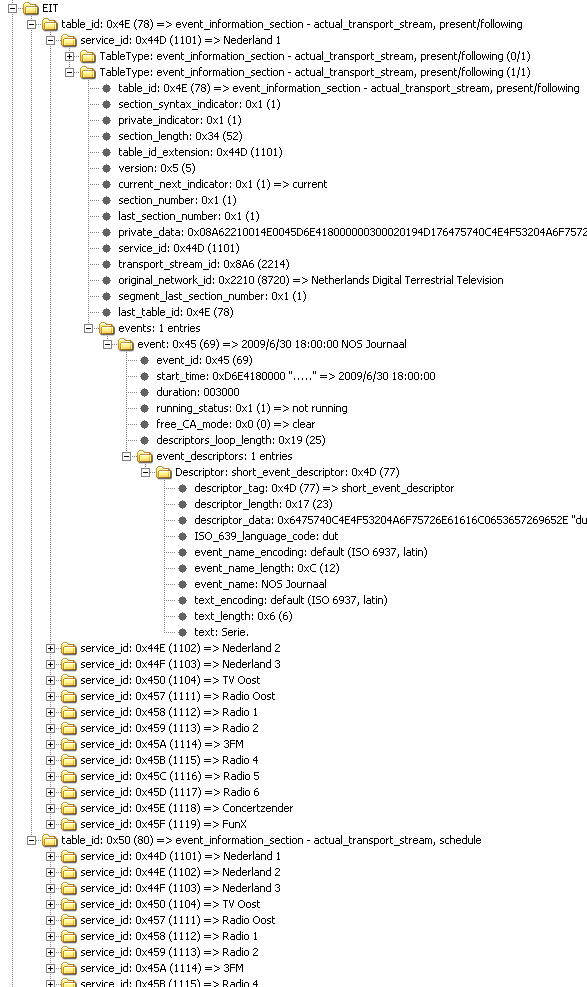
Four types of EIT are possible,
distinguishable by the use of different table_ids:
- actual TS, present/following event information = table_id = "0x4E"
- other TS, present/following event information = table_id = "0x4F"
- actual TS, event schedule information = table_id = "0x50" to "0x5F"
- other TS, event schedule information = table_id = "0x60" to "0x6F"
Only the first type (actual TS, present/following) is required, all others are optional. Digitenne also uses the "actual TS, event schedule information".
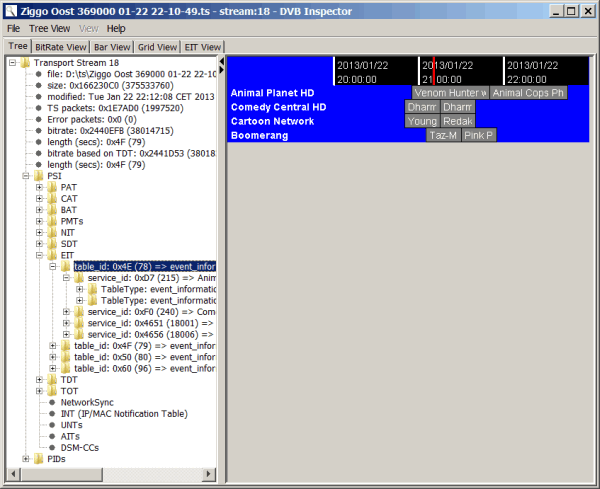
When selecting a table
there is a graphical preview on the right for each separate
table_id (like 0x4E for actual_transport_stream,
present/following).
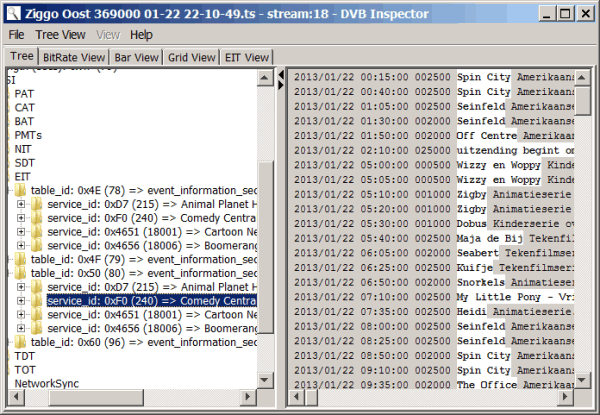
When selecting a
service within a table there is a preview on the right with a
listing of all events in that table for that service.
TDT
The Time and Date Table (TDT) carries only the UTC-time and date information.
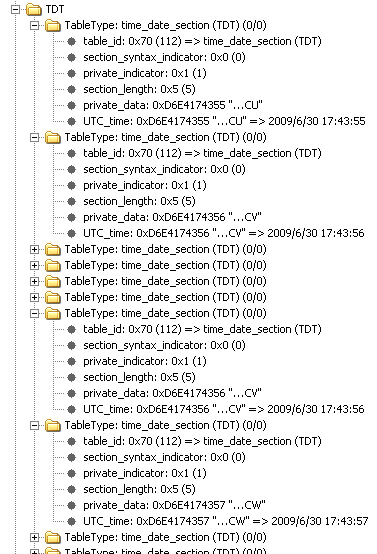
The TDT shall be
transmitted at least every 30 s, according to "DVB; Guidelines on
implementation and usage of Service Information (SI)", but this
service transmits it several times per second.
TOT
The Time Offset Table (TOT) carries the UTC-time and date information and local time offset.
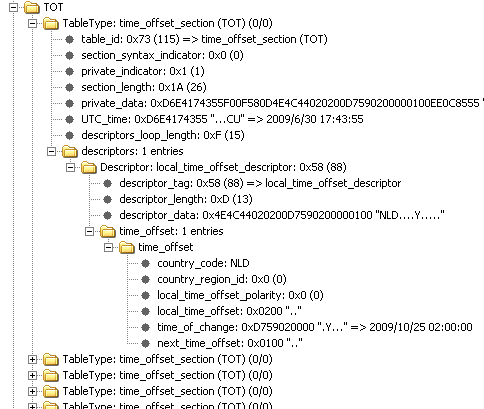
Transmission of the TOT is
optional, but if present it shall be transmitted at least every 30
seconds. Again here it is transmitted several times per second.
SIT
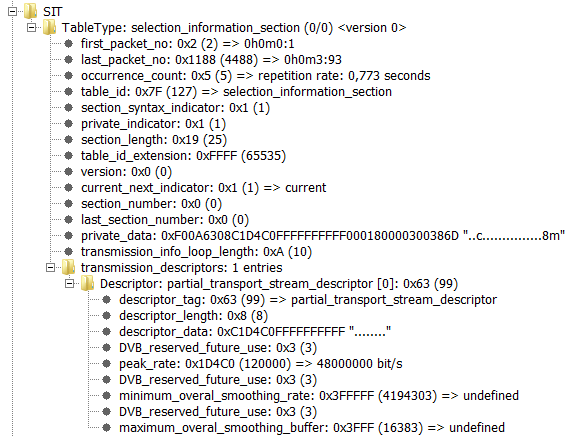
THe Selection Information Table (SIT) is used only in "partial" (i.e. recorded) bitstreams. It carries a summary of the SI information required to describe the streams in the partial bitstream. It can be found on Blu-ray streams.
NetworkSync
Mega-frame Initialization Packets (MIP), are used for DVB-T
broadcast for synchronization of Single Frequency Networks (SFN).
It's use is defined in ETSI TS 101 191 (DVB mega-frame for Single
Frequency Network (SFN) synchronization ) 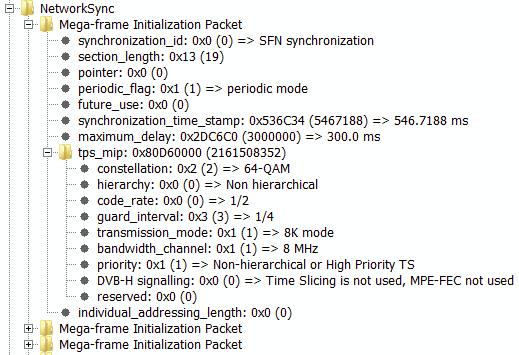
A MIP consists of a single MPEG
Transport Stream packet, wit PID value 0x15. For DVB Inspector
everything wit PID 0x15 is always interpreted as MIP.
INT
The IP/MAC Notification Table (INT) is used in the DVB-H network for the signaling of the availability and location of IP/MAC streams. This table is defined in ETSI EN 301 192 (DVB specification for data broadcasting), § 8.4.4
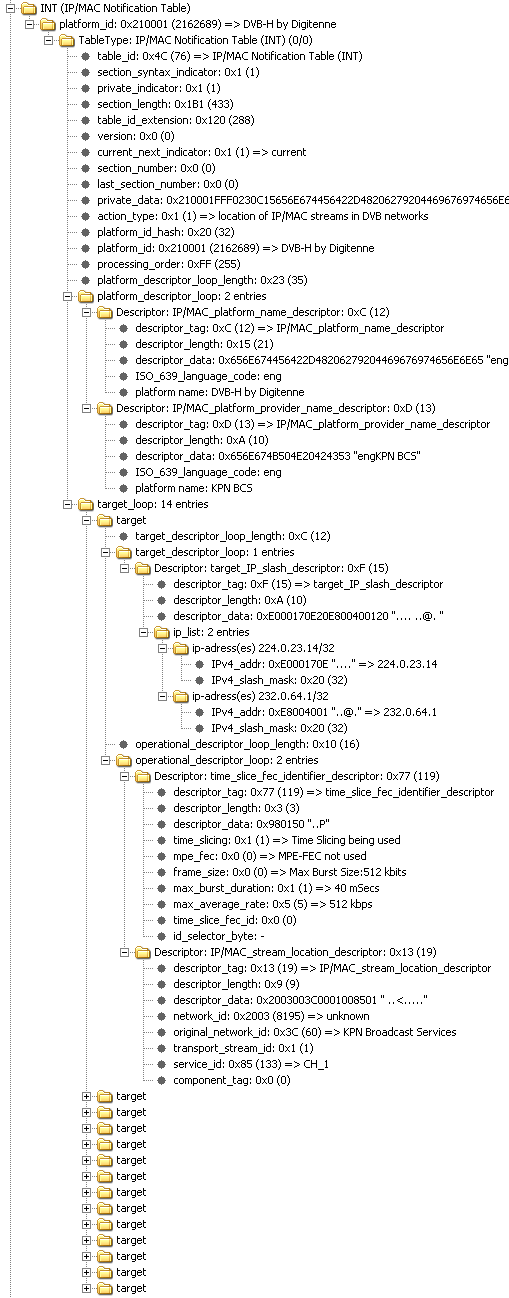
This is the INT
as used in the DVB-H service of Digitenne.
UNT
The Update Notification Table (UNT) provides a standard mechanism for carrying additional information, e.g. update scheduling information, extensive selection and targeting information, action notification, filtering descriptors for System Software Updates. It is defined in "ETSI TS 102 006, Digital Video Broadcasting (DVB); Specification for System Software Update in DVB Systems"
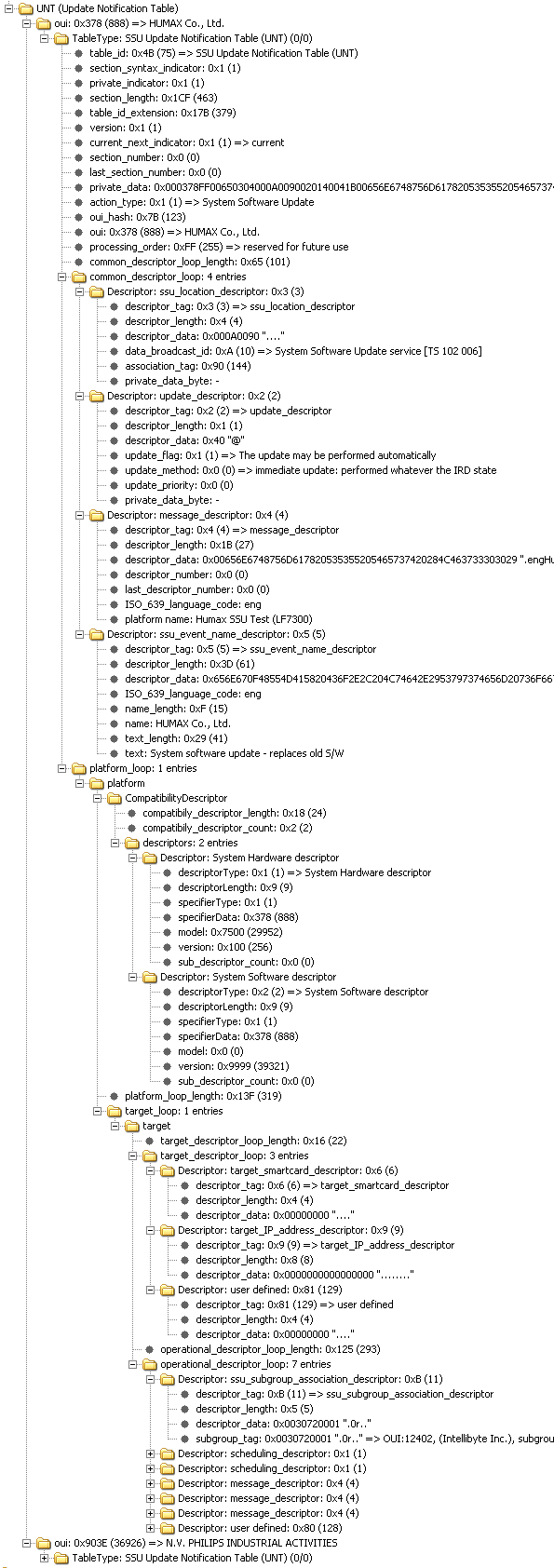
This is a UNT as
once used by Dutch cable provider Ziggo for test purposes.
AIT
The Application Information Table (AIT) is used for "interactive applications", such as HbbTV and MHP. It is defined in "ETSI ES 201 812, Digital Video Broadcasting (DVB); Multimedia Home Platform (MHP) Specification 1.0.3", with additional descriptors defined in "ETSI TS 102 796, Technical Specification, Hybrid Broadcast Broadband TV"
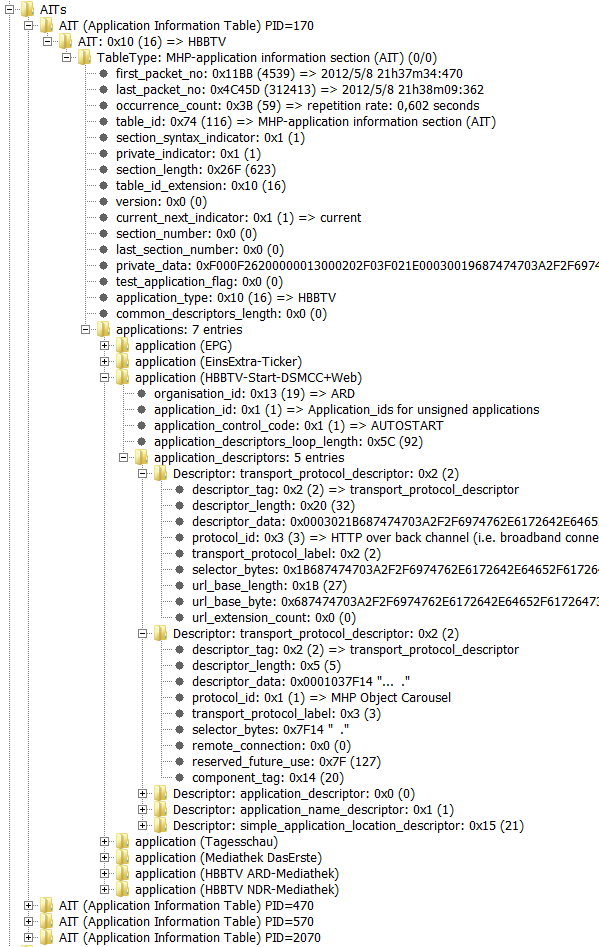
Below the AIT from the ARD transport stream, showing the 7 HbbTV applications for the German ARD-service.
RCT
The Related Content Table (RCT) carries links related to the content currently being broadcast. It is defined in "ETSI TS 102 323, Digital Video Broadcasting (DVB); Carriage and signalling of TV-Anytime information in DVB transport streams"
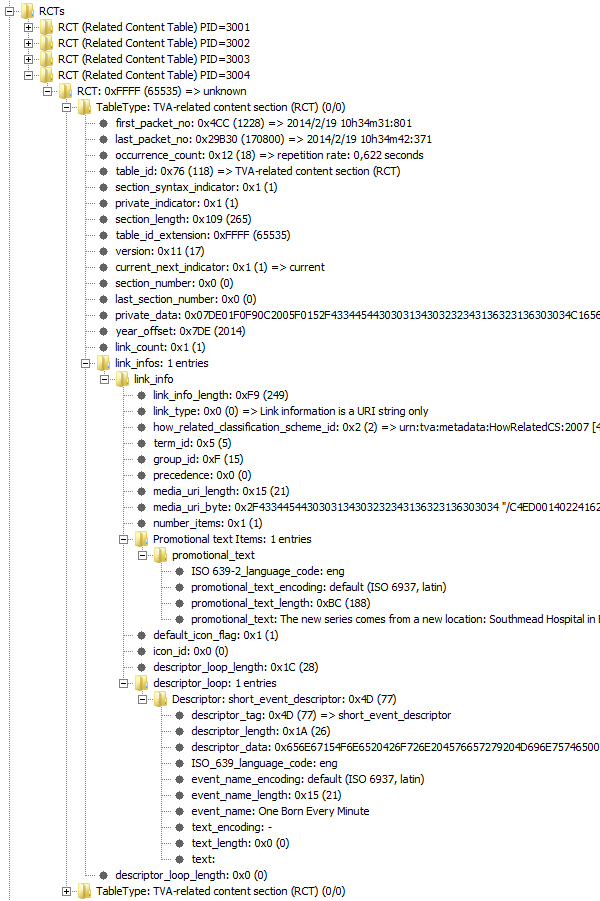
Below the RCT from the UK DVB-T service, where it is used for signaling promo's so the user can schedule a recording.
DSM-CC

DSM-CC parsing can take a lot of memory. That is why it can be disabled in the settings menu.
DSM-CC (Digital Storage Media - Command & Control) is defined in ISO/IEC 13818-6. One of its uses is to transmit object carousels in MPEG transport streams. These can be used to transmit interactive applications, like HbbTV and MHP. DVB Inspector supports Obect Carousels for the following types (data_broadcast_id);
- DVB object carousel (0x0007)
- MHP Object carousel (0x00f0)
- MHEG5 (The Digital Network) (0x0106)
- HBBTV Carousel (0x0123)
- OIPF Object Carousel (0x0150)
- BBG Object Carousel (0xBBB2)
DSM-CC is a very complex standard, and I will not pretend to understand it all. To learn more about DSM-CC TV Without Borders is a good place to start.
These are the assumptions I have made while implementing Object carousels in DVB Inspector. Please correct me if I'm wrong, and also if you have suggestions for a better visualisation.
- An object carousel can consist of several PIDs with ISO/IEC 13818-6 type B data
- A service can contain multiple object carousels, all sharing the same PIDs.
- A PID with ISO/IEC 13818-6 type B data can belong to multiple services.
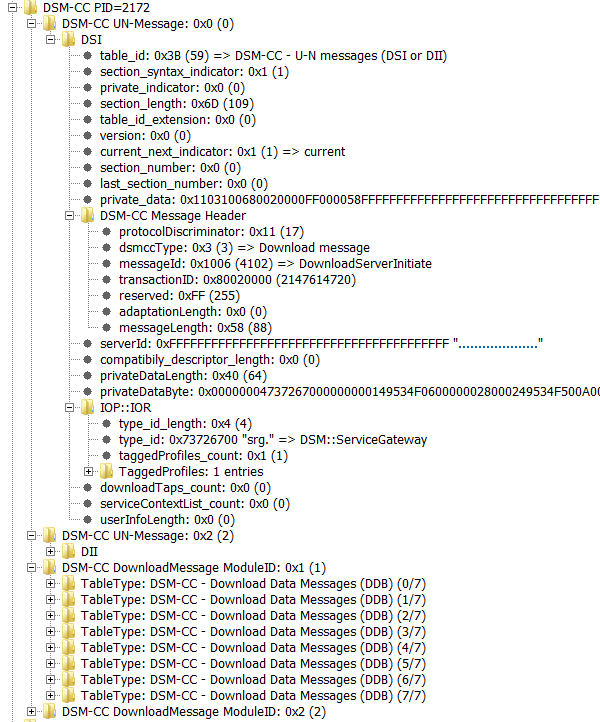
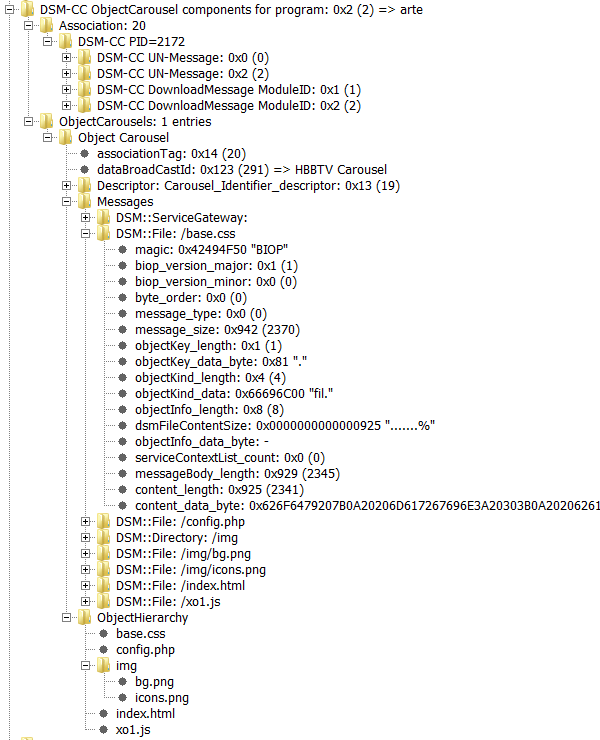
This is how DVB Inspector shows DSM-CC data; first all the PIDS
that contain ISO/IEC 13818-6 type B data (in this case only one
with PID=2172). Then per service all the Object carousels(s) data,
with associations.

Per PID the message types are shown; DSI (DownloadServerInitiate)
and DII (DownloadInfoIndication), together with the Download Data
messages;
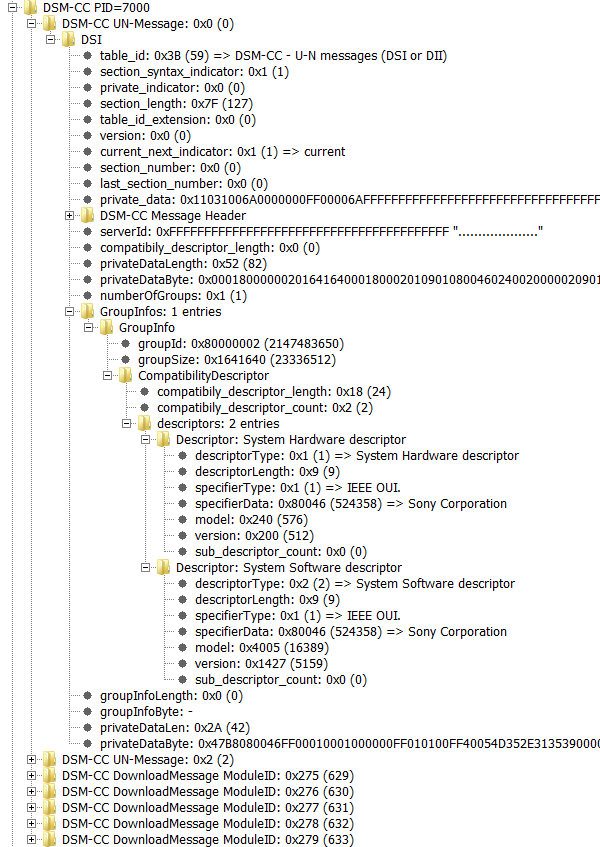
In this section also System Software Update (SSU) carousel data
PIDs are shown;
Then a section shows the object carousel(s) for a single service.
First it shows all used PIDs, ordered by association. Then for
each object carousel in that service all BIOP Messages are shown,
and the object hierarchy with all directries, files and events.
Export Object Hierarchy
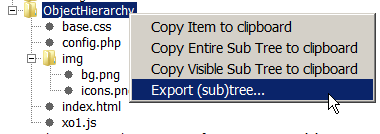 When a directory
is selected in the object hierarchy, the entire sub tree can be
exported to the local file system.
When a directory
is selected in the object hierarchy, the entire sub tree can be
exported to the local file system.
Save as
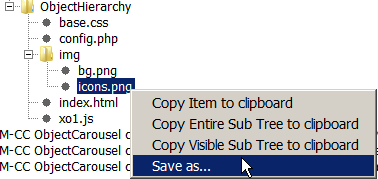 When a file is selected in the
object hierarchy, the file can be saved to the local file system.
When a file is selected in the
object hierarchy, the file can be saved to the local file system.
SCTE-35
SCTE-35 (Digital Program Insertion Cueing Message for Cable) is defined in ANSI/SCTE 35 2014. It is used for signalling local ad insertion opportunities and to insert local TV programs in a national program.
At the moment DVB Inspector supports splice_null, splice_insert, time_signal and bandwidth_reservation commands. If you have any streams available with not supported fields or commands please contact me to help improve DVB Inspector.
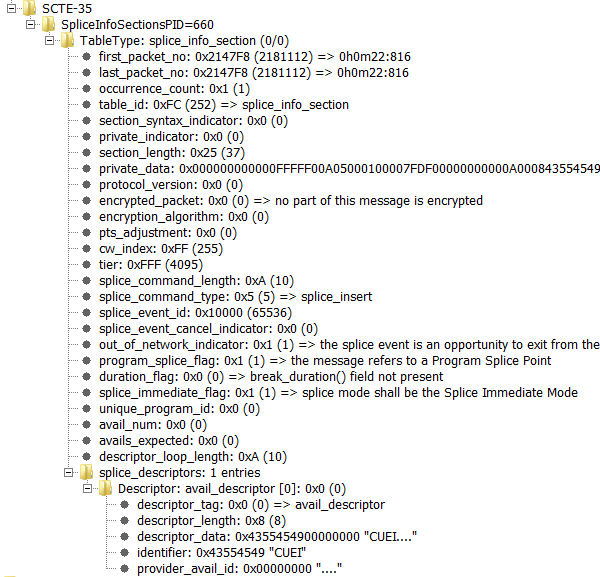
When a program has splice_insert commands, these are displayed in the PCR/PTS-Graph.
DFITs (Downloadable Font Information Tables)
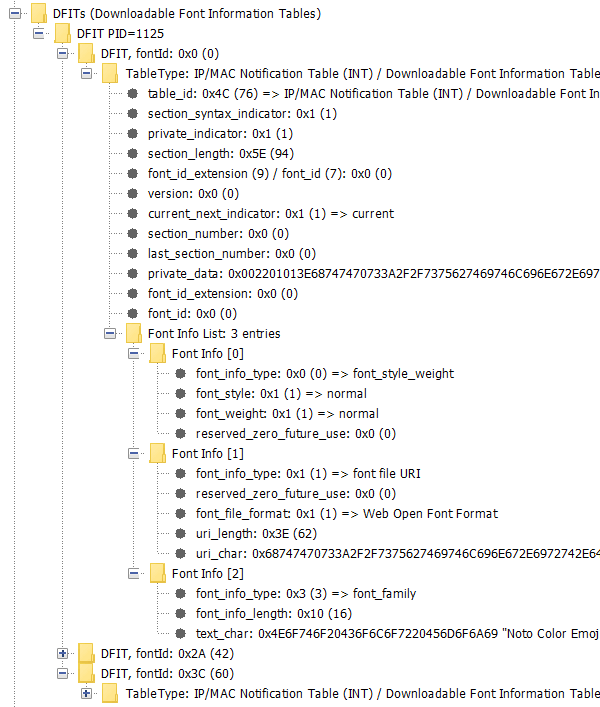
The Downloadable Font Information Table (DFIT) is defined in EN 303 560 V1.1.1. It is used for Timed Text Markup Language (TTML) subtitling. It is used to indicate the download location and font metadata for fonts.
M7 Fastscan
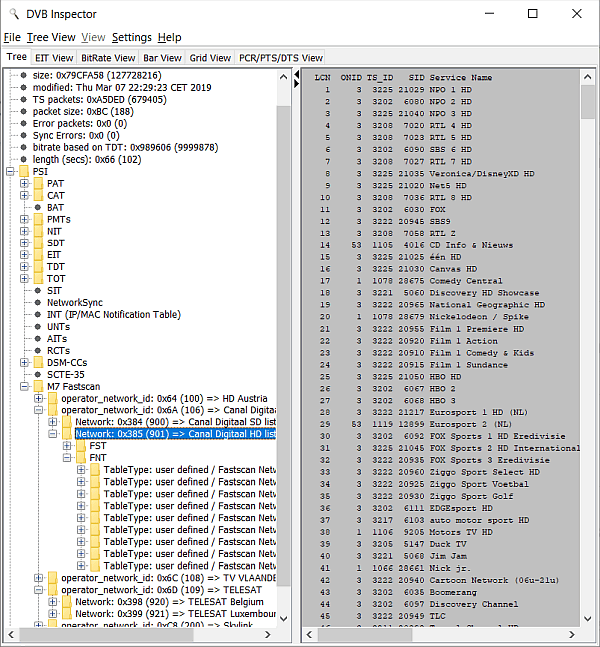
The European satellite
operator M7 uses a non (DVB) standard way of signaling which
channels can be received by their customers, either in the
subscription package, or FTA. When this option is enabled in settings
the PSI section in the DVB tree will show an entry for M7
Fastscan, and when a operator network is selected the channel list
for that operator will be shown in the details panel. The mechanism uses
a Fastscan Services Table (FST) and a Fastscan Network Table (FNT, basically a modified NIT)
to provide a complete list of sevices, without depending on PSI in other streams.
Multiple versions
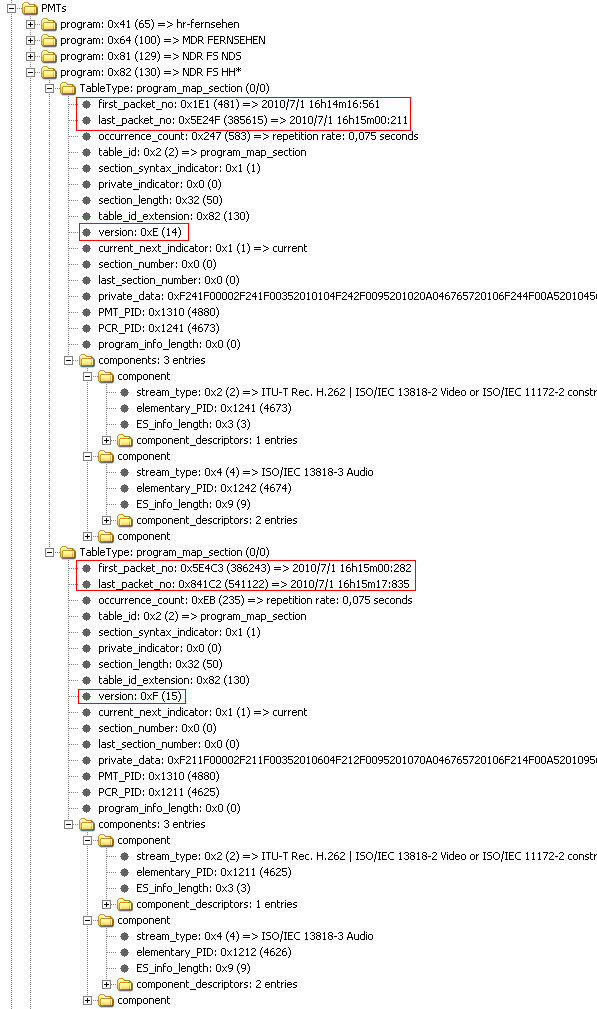
For all PSI data DVB Inspector supports multiple versions of a table. So if a table changes in the middle of a capture, you can see both the old and new values. Below is an example of a PMT with two different versions. The German broadcaster NDR has regional variations from 18:00 until 18:15 (16:00 to 16:15 UTC). The PMT for service NDR FS HH* has version 0xE until 16h15m00:211, and then the version is increased to 0xF. Also the PIDs of the audio and video components are updated.
This page was last modified on 11/10/2020